
Number one
The drop: where the curtain finishes
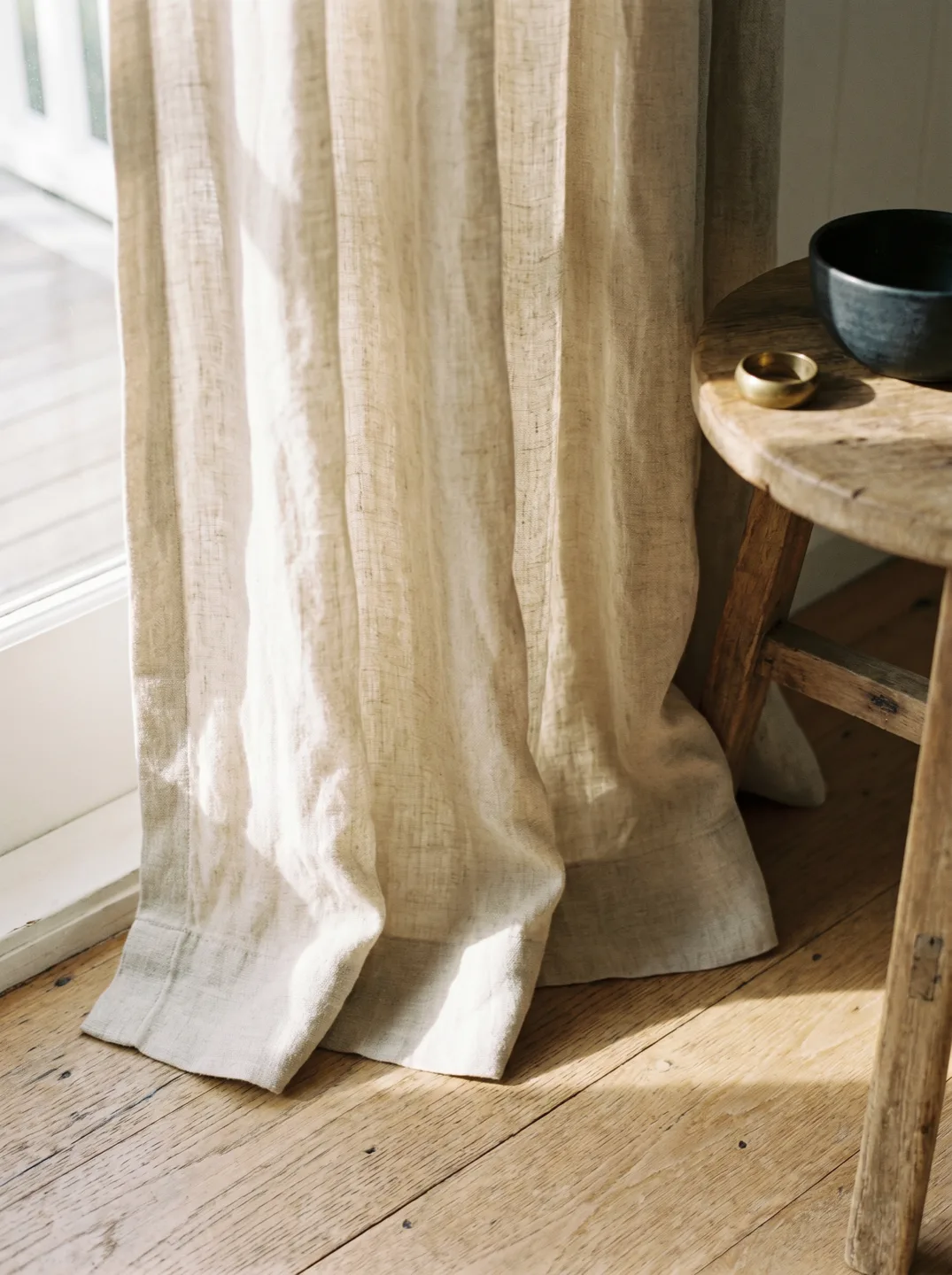
The drop is the finished length, and the finish line is a taste decision with three honest options at the floor:
- The kiss: the hem just touches the floor. Crisp, tailored, our default for most rooms. It has no tolerance for guesswork, which is why we measure at several points; floors are rarely as level as they look.
- The break: a couple of centimetres of extra length so the hem folds softly on the floor, like trousers on a shoe. Relaxed, forgiving, beautiful in linen.
- The puddle: deliberately long, pooling on the floor. Romantic and generous, and a commitment: puddles collect dust and pets, and want re-dressing after every clean.
Above the floor there is really one rule: to the sill or well past it, never in between. A curtain hovering mid-wall shortens the whole room. Sill-length earns its place at kitchen benches, window seats and radiators.
Number two
Fullness: how much fabric the fall needs
Fullness is the ratio of fabric width to track width. At one-to-one you have a flat bedsheet; around double you have a curtain. Each heading has its own appetite: an S-fold wants its double to make the wave, a pinch pleat drinks a little more into its folds, an eyelet needs slightly less because its folds run deep.
Fullness is where cheap curtains quietly cheat, and it is unfixable after the fact: you cannot add cloth to a skimped curtain. It is also why a made-to-measure quote talks in fabric widths rather than window widths; the difference between them is the curtain.
Number three
Stack-back: where the curtain lives when open
Open curtains have to stand somewhere. The stack-back is that parking space, and planning it is the difference between a window you dressed and a window you shrank. On a view window we run the track wide of the glass so the open folds stack against the wall, not the harbour. In a tight terrace reveal we will tell you honestly how much glass the stack will hold, and whether a roman blind would serve the room better.
Numbers four and five
Returns and overlap: sealing the edges
Light is a fluid; it finds edges. The return is the short wrap of fabric that turns the corner at each end of the track back to the wall, and the overlap is the generous crossing where two curtains meet in the middle. Skip either on a blockout drape and the room gets a glowing picture frame at dawn. They cost centimetres, they are decided at the measure, and they are most of the reason a made blockout outperforms a bought one.
The last five per cent: dressing in. When we hang your curtains we dress the folds by hand, setting each column and letting the fabric learn its shape. Give a new curtain a few weeks of being drawn kindly and the fall becomes muscle memory. That is not mystique; it is just cloth.
Measured twice, sewn once, dressed by hand. That is the entire secret.