
Home · Guides · Fabric weight & light
The fabric guide
Curtain fabrics: sheer to thermal-lined
Blind catalogues explain fabric with percentages and openness factors. A workroom explains it the way you will live with it: what the room looks like at ten in the morning and what the street sees at ten at night. Four weights, told in cloth.
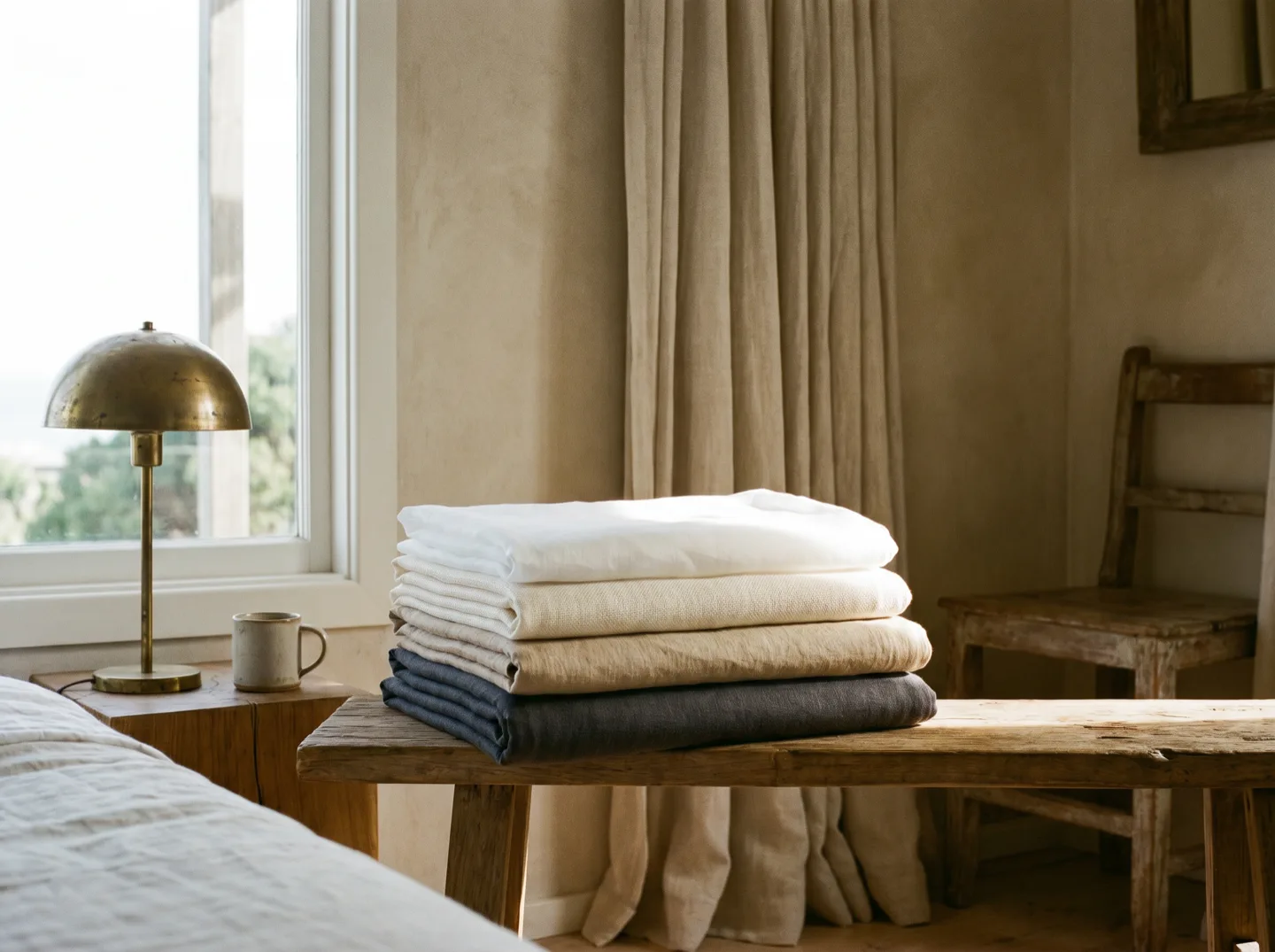
Weight one
Sheer: light in, glare out
Voiles and open weaves. Daylight comes through diffused, the view stays readable, and daytime privacy holds because the bright side is outside. The honest limit: at night the physics flips. Once your lamps are brighter than the street, a sheer alone is a stage curtain and you are the show. Sheers live their best life layered with something solid behind them.
Weight two
Light-filter: the soft middle
Denser than a sheer, still unlined. Daylight arrives as an even glow, shapes blur to silhouettes in both directions, and the room keeps a sense of the day without its glare. This is the terrace front-room fabric, and the home-office fabric for anyone tired of screen reflections. Its limit: it softens light but does not stop it, so it will not darken a bedroom or hold back a western afternoon on its own.
Weight three
Blockout-lined: darkness on demand
A face fabric you choose for looks, backed with a lining whose one job is stopping light. Done properly, with a measured overlap and returns, the room goes dark enough for shift sleep and day naps. The limit is the fit, not the fabric: blockout cloth with gaps around it is just an expensive picture frame for daylight. This is the weight where made-to-measure stops being a luxury and starts being the point.
Weight four
Thermal-lined: the comfort layer
An insulating lining that slows heat crossing the glass in both directions: winter warmth stays in, summer radiance stays out, and most light stops with it. Windows are the weak wall of most Australian homes, and the Australian Government's YourHome guidance is straightforward about the fix at the fabric end: close-fitting, floor-length lined curtains, sealed at the top with a pelmet, make a real difference to heat loss through glazing. We will not put a number on your windows from a web page; we will say that in Fletcher and Cameron Park, where new estates face the western sun with young gardens and big glass, this is the weight we quote most.
The night test
One question that picks the weight
Stand in the room and ask: what should this window do at 10pm? The answer nearly always names the fabric.
| At 10pm this room should be... | Then the weight is | And by day |
|---|---|---|
| Softly lit, view still there, nobody watching in | Sheer + blockout on a double track | Sheer working alone |
| Private, cosy, light optional | Blockout-lined drapes | Drawn back to the stack |
| Pitch dark for sleep | Blockout-lined, overlap and returns specified | Whatever the second layer says |
| Warm without the heater arguing with the window | Thermal-lined, floor length, pelmet on top | Open to the winter sun |
| Nobody is in it at 10pm (kitchen, study) | Light-filter, or a roman blind | Soft, even glow |
Hold the swatch up to your own window at the time of day that bothers you. That is the entire test, and it is why we come to you.