
Home · Guides · Material for curtains
Material for curtains: which fabric suits which room
Choose curtain fabric for the job each room has to do: sheers in cotton or linen for light with privacy, man-made fibres for hard afternoon sun, a coated fabric for total blockout, velvet for a cosy room, then hang it to the floor, wrapped to the wall and under a pelmet so the fabric can do that job.
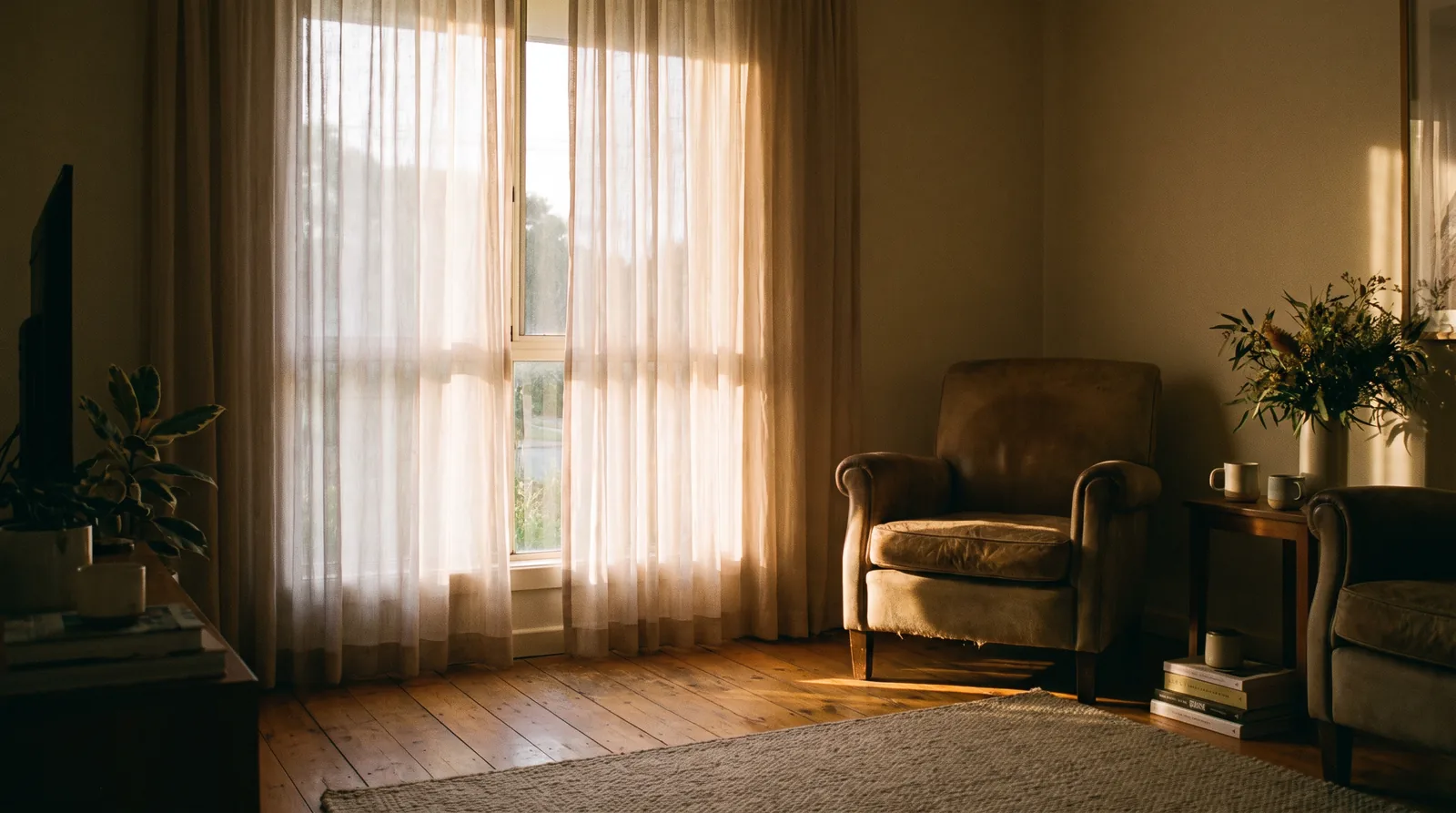
Pick a curtain fabric for what the room has to do, then hang it so the fabric can do that job. Sheers in cotton or linen give privacy and keep the light. Man-made fibres stand up better to hard afternoon sun. A coated fabric is the one that gives total blockout. Velvet suits a bedroom or sitting room you want to feel warm.
The fit matters as much as the cloth. Here is our count from the ACT Government's advice on choosing curtains. It names six things that help a curtain hold heat. Three are about the fabric: a tight weave, layers that trap air, and an attached block-out backing. Three are about how it hangs: reaching the floor, wrapping to the wall, and a pelmet on top. Half the list is fit.
Which curtain material suits which room
| Room and job | Fabric to start with | Why | Source |
|---|---|---|---|
| Bedroom, full dark | Coated blockout fabric | The choice for 100% blockout | Homes To Love, curtain fabric tips |
| Bedroom, some glow is fine | Triple-weave | Blockout with some light filtering | Homes To Love, curtain fabric tips |
| Street-facing living room | Sheers in natural cotton or linen | Privacy without blocking light | Homes To Love, buyer's guide |
| West-facing or strong afternoon sun | Man-made fibres or linen-look polyester sheers | They fade and deteriorate more slowly than linen or cotton | Homes To Love, curtain fabric tips |
| Cosy bedroom or sitting room | Velvet | Good thermal qualities | Homes To Love, buyer's guide; Homes To Love, curtain fabric tips |
| Light by day, privacy by night | Sheer in front of a drape on a double track, or sheers in front of a blockout roller blind | Sheer for light and privacy, drape or blind for blockout | Homes To Love, curtain fabric tips; Homes To Love, buyer's guide |
| Nursery | Blockout, plus cords installed to the national mandatory standards (nsw.gov.au) | Blockout for daytime sleep | NSW Government, for the cords only |
Start with the room's job, not the swatch book. A bedroom that has to be dark at 6 am needs a different fabric from a front room that needs privacy from the street at noon.
The table above is the short version. The sections below explain each choice, and the reasons are what you will need when two fabrics look equally good on the sample rail.
Types of curtain fabric, from sheer to blockout
Curtain fabrics sit along a scale from see-through to light-tight. Homes To Love, which put the question to a fabric supplier's managing director, sums it up: lighter fabrics add a soft and dreamy touch, while heavier fabrics block light better.
Most homes need more than one point on that scale. You might want a sheer in the living room, a blockout in the main bedroom and something in between for a study. Our curtain fabric guide goes further into weight and light.
Sheer material for curtains: privacy with the light left in
Sheers do one thing very well. They let natural light in and keep privacy, and the same source notes they can be layered over roller blinds or shutters.
Homes To Love's buyer's guide suggests that for privacy without blocking light, choose sheer curtains in natural cotton or linen.
The catch is night-time. Once the lights are on inside, a sheer shows more than it does by day, so a street-facing room usually wants a second layer. You can see the styles on our sheer curtains page.
Linen and cotton, or linen-look polyester
| Linen or cotton (natural) | Linen-look polyester (man-made) | |
|---|---|---|
| Look | A designer quoted favours linen in soft greys and muted pastels for a contemporary look | The linen look |
| Source: Homes To Love, buyer's guide | ||
| Creasing | Linen: more creasing. Cotton: not stated | Less creasing |
| Source: Homes To Love, curtain fabric tips | ||
| Strong afternoon sun | Fades and deteriorates faster | Fades and deteriorates more slowly |
| Source: Homes To Love, curtain fabric tips | ||
Natural fibres have the look most people are after. A designer quoted in the same guide says linen in soft greys and muted pastels looks contemporary.
The trade-off is wear. The supplier quoted earlier says that in rooms with strong afternoon sun, man-made fibres fade and deteriorate more slowly than natural fibres such as linen or cotton.
There is a middle path. Linen-look polyester sheers give the linen look with less creasing, which matters in a long drop where every crease shows.
The best material for curtains in a west-facing room
A west window takes the hardest light of the day, low and straight in, for hours. That is the room where the fade point above stops being theory. We would lean towards man-made fibres or a linen-look polyester there, and keep pure linen for the softer light of an east or south window.
This year makes the point sharper. The Bureau of Meteorology's outlook issued on 1 October 2026 gave most of NSW over an 80% chance of unusually high maximum temperatures from October to December.
How you use the curtain matters too. The ACT guidance says that in summer, close curtains by day and open them in the evening.
Blockout material for curtains: triple-weave or coated
Light still gets in around the edges unless the curtain is fitted closely.
If you have been searching for blackout curtain material, the Australian word is blockout, and it comes in two kinds that are easy to mix up.
A triple-weave fabric gives blockout with some light filtering, meaning the room goes dim but not black. The same source says that for 100% blockout, choose a coated fabric.
Even a coated fabric only stops the light that hits it. Light around the sides and over the top is a fit problem, and the fit section below deals with it.
Lining material for curtains: attached, not bonded
- 1Block-out backing
- 2Attached but not bonded
- 3Tightly woven materials, trapping air in as many layers as possible
- Radiant heat held back in winter
- Summer heat kept out
A lining turns a good-looking face fabric into a working curtain. The ACT Government advises lining curtains with a block-out backing to prevent radiant heat loss and reduce summer gain, and says the backing should be “attached but not bonded”.
That detail is the point. A separate lining stitched in at the top and sides leaves a layer of still air between the two fabrics. The same guidance favours “tightly woven materials, trapping air in as many layers as possible”.
A lining also protects the face fabric from direct sun, which helps in that west room. See drapes and lined curtains for how these look made up.
Velvet material for curtains: the cosy room
Velvet is a mood as much as a fabric. A designer quoted in the buyer's guide says velvet suits a cosy bedroom or sitting room, and the supplier quoted earlier notes that velvet has good thermal qualities.
It is heavy, so plan the hardware with it. A long velvet drop needs a track or rod that can carry the weight without sagging. Our guide to tracks, rods and pelmets covers the options.
Thermal material for curtains: the fit does half the work
Windows are where a house leaks. The federal Your Home guide says up to 40% of a home's heating energy can be lost, and up to 87% of heat gained, through windows, and that curtains and blinds can improve a window's thermal performance, especially on existing windows. A related page notes that heat loss is further minimised with an appropriate choice of windows and curtains or blinds.
A heavy or "thermal" curtain does not do the job on its own. Your Home says heavy fabrics and multiple layers help, but the benefit is reduced if there is air movement around the curtain.
That fit has three parts. The ACT advice is to make curtains reach the floor and wrap to the wall either side of the window, and to pair them with box or corflute pelmets. The pelmet matters because, as Your Home puts it, curtains with pelmets trap a layer of still air next to the window.
On length, a designer's ideal is about 10 mm off the floor. Puddled hems drag on tile, timber or laminate and collect dust. In our reading, 10 mm still counts as reaching the floor, so you do not have to choose between a neat hem and a warm room. There is more in how curtains should fall.
Use them with the seasons. In winter, the ACT guidance is to open curtains by day for sun and close them at night.
Sheer and blockout in one window
Sheer for light and privacyDrape or blind for blockout
You do not have to pick between light and dark. With a double track, the sheer can hang in front of the drape, so the room looks soft by day and closes up at night.
Another designer's suggestion is blockout roller blinds for privacy and light control, with sheers in front for ambience. That suits a window where a second curtain stack would crowd the wall.
See day and night curtains for the two-layer set-up, or blinds if a blind is the back layer.
Nursery and children's rooms: blockout and safe cords
- 1Cleat at least 1,600 mm above the floor
- 2No loose loop of 220 mm or longer
- 3Keep cots and beds away from cords
- 4Installer's name and contact details
- 5Cannot be cut: use a safety device
A nursery usually wants blockout for daytime sleep, and a lined or coated curtain does that. The other question in a child's room is cords.
National mandatory standards, explained on the NSW Government site, say corded curtains and blinds must be installed so a loose cord cannot form a loop of 220 mm or longer at or below 1,600 mm above the floor. A cleat securing a cord must sit at least 1,600 mm above the floor, and the installer must label the product with their name and contact details.
Two more points from the same page. Keep cots and beds away from cords. Some pull-cords need a continuous loop and cannot be cut, so a safety device is needed instead.
How to pick a curtain fabric
A swatch on a counter tells you very little. Hold samples against the actual window, at the time of day you use the room, and look at them from inside. A sheer that glows in the morning can look grey at dusk.
Then feel the weight and picture the drop. A fabric that drapes well over your hand may still crease or swing in a three-metre fall. The supplier quoted earlier notes that lead-weighted curtains help with drop length and a neat hem.
Fabric and heading work together. The fabric sets the weight, and the heading sets how it folds and how much wall it needs when open. Last week's guide to types of curtain headings covers that side, and the Fold & Fall Planner helps you think it through window by window.
The figures to keep beside you
Five numbers, all checked and linked above: the share of heat lost and gained through windows, the 10 mm hem, and the two cord measurements for any room a child sleeps in.
Choosing fabric with Curtains Newcastle
The quickest way to settle this is room by room. Note which way each window faces, what time of day the room gets used, and whether it needs to be dark, private, warm or all three. Then send that list to Curtains Newcastle when you book a measure and quote, and we can talk through fabric, lining and fit for each window.
Sources
- https://www.homestolove.com.au/decorating/expert-tips-on-how-to-choose-curtain-fabric-15942/
- https://www.homestolove.com.au/decorating/buyers-guide-to-curtains-and-blinds-9777
- https://www.climatechoices.act.gov.au/energy/energy-efficiency/window-glazing-or-treatments
- https://www.yourhome.gov.au/passive-design/glazing
- https://www.yourhome.gov.au/passive-design/passive-heating
- https://www.nsw.gov.au/legal-and-justice/consumer-rights-and-protection/safety/other-consumer-products/blind-and-curtain-safety
- https://www.bom.gov.au/climate/ahead/outlooks/archive/20261001-outlook.shtml