
Home · Guides · Wet curtains after a roof leak
Wet curtains after a storm roof leak: what to do in the first two days
Get safe, photograph the damage and call your insurer before you clean up, then get wet curtains drying with doors and windows open, because mould can start on damp surfaces within 24 to 48 hours, and absorbent items that can't be cleaned easily should go once they've been wet more than two days, kept somewhere dry until your claim is processed.
If a storm pushes water through your roof and onto your curtains, you have about a day to get them drying, not a week. Two government guidelines set that clock.
- The Victorian Government's general insurance guidance says mould can start growing on damp surfaces within 24-48 hours.
- The Queensland Government says absorbent items that can't be cleaned easily should be thrown away if they are wet for more than 2 days.
Put those side by side and mould can get going before you reach the two-day line. Our estimate is that the first 24 hours are when you have the most choices. Neither source says that in those words. It is our reading of the two together, and it is no guarantee either way.
This happens a lot in a NSW storm season. Last storm season, according to NSW SES, it responded to more than 23,416 incidents, and more than 6,500 of them were for leaking and damaged roofs. By our working, that is about 28 per cent (6,500 ÷ 23,416), or more than one in four. Both SES figures are "more than" counts, so treat that share as a rough estimate.
Here is the order to work in, from the first hour to the day you think about new curtains.
How long can curtains stay wet before mould starts?
- Leak foundSafety first, photograph the curtains hanging, then take them down and air the room.
Vic Government - 24-48 hours"Mould can start growing on damp surfaces within 24-48 hours" (Vic Government, general insurance guidance).
Vic Government - More than 2 days wetAbsorbent items that can't be cleaned easily "should be thrown away" (Qld Government), but store them in a dry place until the insurance claim is processed (WA Health).
Qld Government · WA Health - Days or weeks laterMould colonies often appear after the water has gone (Vic Government).
Vic Government
Not long, and you may not see it starting. Because mould can start so quickly, the same Victorian page notes that colonies often appear days or even weeks after the water has gone. A curtain that looks clean on day three may not be.
So don't leave wet curtains hanging against a damp wall or bundled in a laundry basket. Fabric folded on itself holds water where air can't reach it. Once it is safe to work near the window, take them down and get air across them.
Queensland's two-day line covers absorbent items that can't be cleaned easily. Washable items are handled differently, as the triage below explains.
What should I do in the first hour after a roof leak?
- Life at risk? Call Triple Zero (000). Storm emergency help: NSW SES 132 500.
NSW SES - Check the structure (windows, walls, roof) before going in, and be especially cautious of contaminants including asbestos.
NSW SES - Don't turn on the power in a flooded home until a qualified person says it's safe, and stay away from fallen powerlines.
Vic Government · NSW SES - Contact your insurer.
Vic Government - Photograph and list the damage before cleaning up, curtains still hanging.
Vic Government - Protect what isn't damaged: move it, or put a tarp over it.
Vic Government
Deal with safety first, then evidence, then protection. The curtains come after all three.
- If a life is at risk, call Triple Zero (000). For emergency help in a storm, the NSW SES number is 132 500.
- Before you go back into a damaged room, NSW SES says to check the structure, including windows, walls and roof, and to be especially cautious of potential contaminants including asbestos.
- Victorian guidance says do not enter a flooded home or turn on the power until a qualified person confirms it is safe. Treat water near light fittings or power points with the same caution. That is our reading, not a quote: if water is coming through a ceiling light or near power points, keep out of the room and get a licensed electrician. Stay away from fallen powerlines, and get professional assessments of damaged structures and electrical items, as the SES Plan to recover advice sets out.
- Then deal with the insurance. The Victorian Government's general steps run in this order: contact your insurer, take photos and list the damage before cleaning up, then take safe and reasonable steps to protect your home and belongings from more damage, such as moving undamaged items or putting a tarp over them.
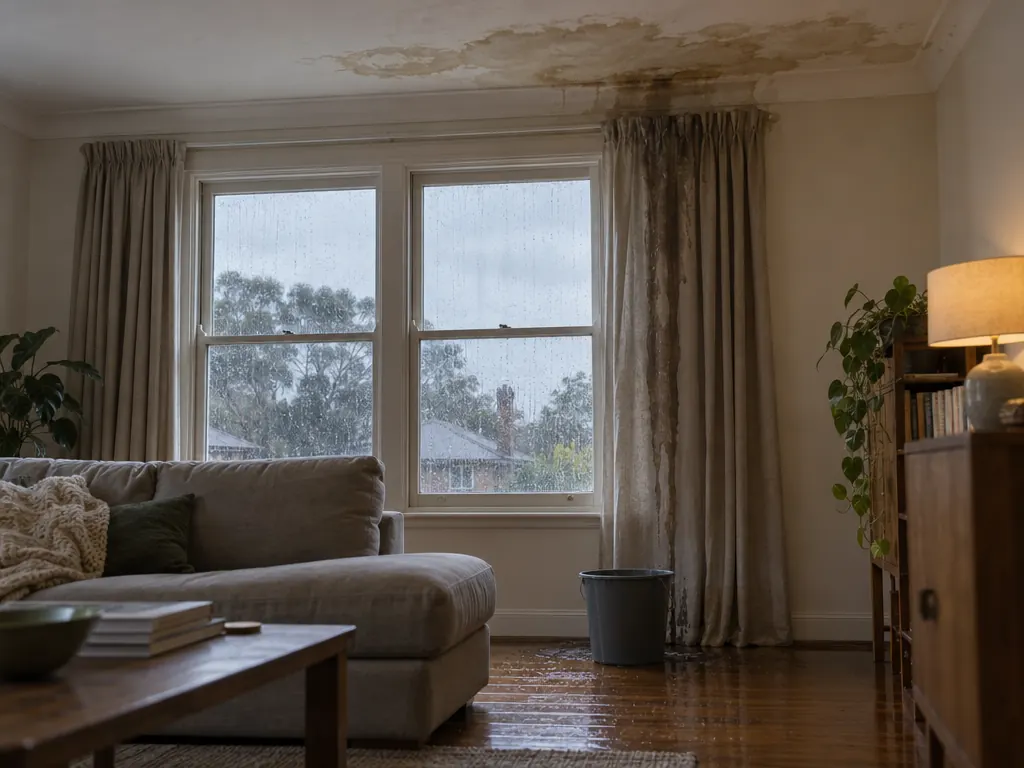
For curtains, "photos before cleaning" means photographing them still hanging. Get the water line, the stained heading, the wall behind and the ceiling above. Then take them down.
Don't climb a ladder onto a wet roof to find the leak. Call SES in an emergency, and a licensed roofer once the weather clears.
What do I do with wet curtains after a roof leak?
WA Health
Qld Government
Qld Government
Qld Government · WA Health
Dry them fast, wash what is washable, and judge the rest against the two-day line.
Air the room. WA Health's advice after a disaster is to open doors and windows to air the house out. It also says not to run air-conditioning or heating that may be contaminated until a qualified person has checked it. A pedestal fan pointed at an open window keeps the air moving.
Wash what can be washed. Queensland's guidance says washable items such as linen should be washed as usual, and "if in doubt, take them to a professional cleaner". Lined, interlined and blockout-backed curtains are built in layers, so they are the ones most worth showing a professional. If you are not sure what yours are made of, our material for curtains guide runs through the common fabrics.
Judge the rest. Absorbent items that can't be cleaned easily should go if they have been wet for more than 2 days. Don't put them out on the kerb yet, though. WA Health says to store discarded items in a dry place until the insurance claim is processed.
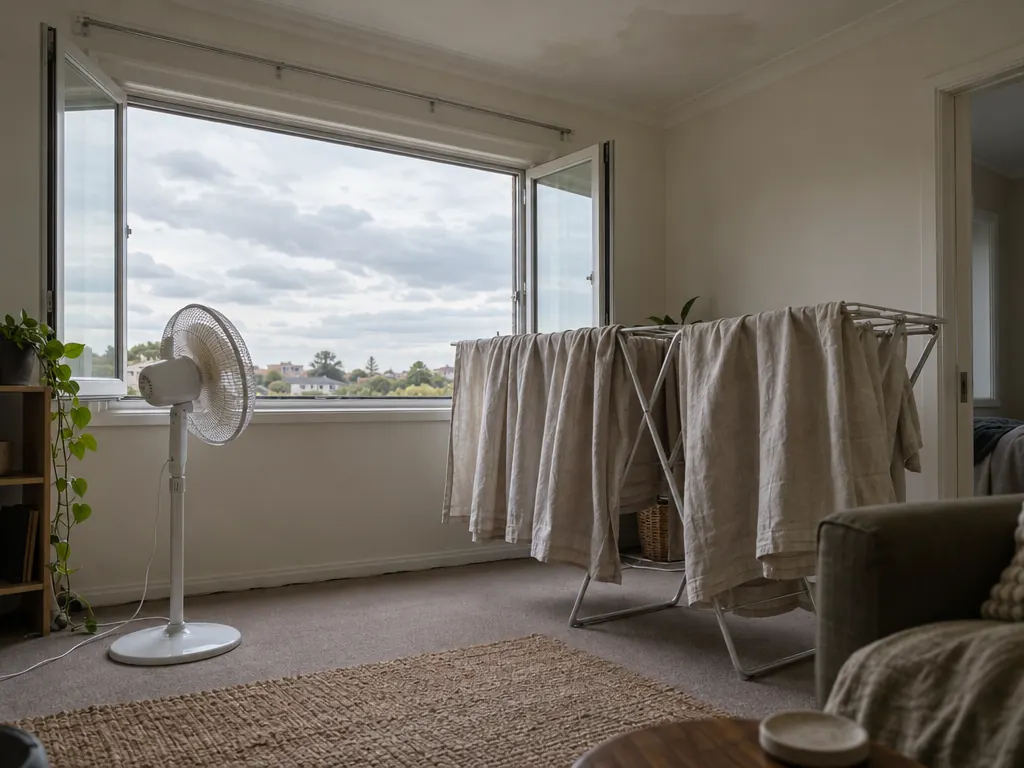
To be clear about what these sources say: they talk about soft furnishings in general. WA Health's list of items to remove includes bedding, furniture and clothing. Victoria's names fabric couches and carpet. Neither names curtains. A curtain is the same kind of absorbent textile, though, and at Curtains Newcastle we would treat it that way.
One more thing for summer. Our usual advice, from the federal energy site, is to close them during the day in warmer months and open them at sunset to keep heat out, as our thermal vs blockout guide explains. Wet fabric is the exception. Take it down and get air through the room.
How do I handle mould on curtains without making it worse?
| Do or don't | Why | Source |
|---|---|---|
| Don't dry-brush mould | It can release spores | Qld Government |
| Wear an N95/P2 respirator for a lot of mould, or if you have allergies | Standard dust masks do not protect you from spores | Qld Government |
| Don't mix cleaning agents | Qld advice | Qld Government |
| Cut the moisture and get leaking roofs repaired quickly | The best way to control mould | Qld Government |
| Remove damaged items that are a health risk | Vic names fabric couches and carpet | Vic Government |
Queensland's mould guidance gives a short list. Don't dry-brush mould, because it can release spores. For a lot of mould, or if you have allergies, wear an N95/P2 respirator, because "Standard dust masks do not protect you".
Bleach is not the fix for mould: the Queensland Government says "Using bleach is not recommended because it's not an effective mould killer".
The same page says bleach does help against disease-causing organisms from contaminated floodwater. Whatever you use, don't mix cleaning agents.
Cleaning only treats the symptom. Queensland says the best way to control mould is to cut the moisture and repair leaking roofs and plumbing quickly. The Victorian guidance adds that you should remove damaged items that are a health risk, such as fabric couches and carpet.
I rent: who pays when the roof leaks onto my curtains?
| Question | NSW answer |
|---|---|
| Is it urgent? | "Serious storm or fire damage" and "a serious roof leak" are both listed as urgent repairs. NSW Government |
| What do I do first? | Tell the landlord or agent straight away. NSW Government |
| Can't reach them? | The tenant can arrange urgent repairs, with written notice, costs and receipts. NSW Government |
| Who pays for that repair? | The landlord must pay reasonable costs within 14 days of notice, up to a cap (see the NSW Government page) (checked November 2026). NSW Government |
| What about the curtains? | Check what is yours and what is the landlord's. NSW Government |
In NSW, serious storm or fire damage and a serious roof leak are both listed as urgent repairs. You must tell the landlord or agent straight away.
If you can't reach them, you can arrange the urgent repair yourself, giving written notice and keeping the costs and receipts. The landlord must then pay the reasonable costs, up to a cap set by the NSW Government, within 14 days of notice (checked November 2026).
Your landlord does not cover your belongings: NSW Government guidance says "Tenants are responsible for maintaining insurance on their belongings", and a landlord is not obliged to compensate for damage to a tenant's furniture or personal belongings.
Curtains can belong to either party in a rental. Some came with the place and some went up with you. Check what is yours and what is the landlord's before anyone lodges a claim, and if you rent without contents insurance, this is the case for getting it.
How does storm water get from the gutter to my curtains?
- 1Leaves and debris block the gutter and downpipe
- 2Trapped water can overflow under the eaves into your roof cavity (NSW SES)
- 3Broken or missing tiles: on the SES list to fix before storms (NSW SES)
- 4Water reaches the ceiling above the window
- 5The curtain heading and fabric take the drip
- Check windows and doors seal properly (NSW SES)
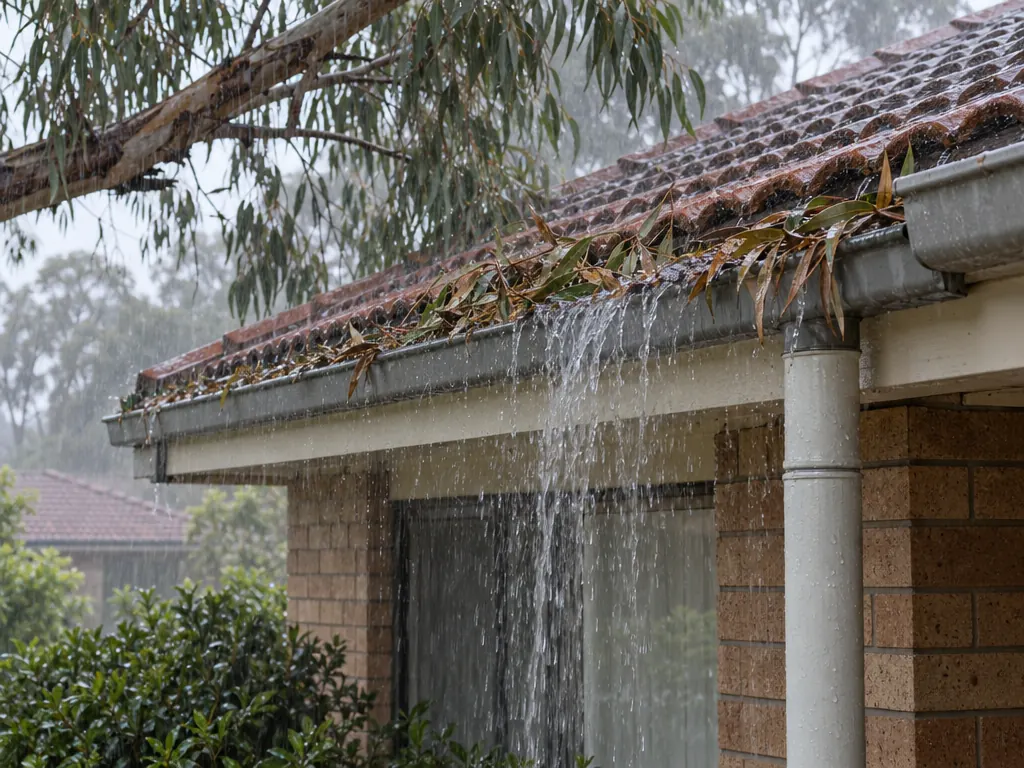
Often it starts at the gutter, not the roof itself. NSW SES says blocked gutters and downpipes can trap water and make it overflow under the eaves into your roof cavity. From there it can come through the ceiling. A leak above a window lands on whatever hangs below it.
Broken or missing tiles are the other route in, which is why fixing them heads the SES Get ready list. SES also advises checking that windows and doors seal properly and getting broken windows repaired.
Roofs are not the only storm job SES handles. Fallen trees account for about 7,000 of last season's incidents, according to the same SES page. Roof leaks are the ones that end up inside, on the curtains.
What should I check before the next storm?
Don't count on dry months ahead. NSW SES says "Storm Season falls between September and April, although a major storm can happen at any time of the year". The Bureau of Meteorology's outlook issued 29 October says above-average rainfall is likely (60% to greater than 80% chance) for November to January across parts of western, central and eastern Australia, including northern NSW, with the wet signal strengthening in the east during December.
The SES Get ready list covers four things:
- fix roof damage, including broken or missing tiles and any leaks
- clean gutters, downpipes and drains
- trim branches
- make sure your insurance is current and covers what you need
On that last point, read how your contents policy treats curtains and blinds, because cover varies from policy to policy. Leave roof work to a licensed tradesperson.
"Storm Season falls between September and April, although a major storm can happen at any time of the year"
NSW SESLast storm season: more than 23,416 incidents, more than 6,500 for leaking and damaged roofs
NSW SESAbsorbent items that can't be cleaned easily: throw away if wet for more than 2 days, but store dry until the claim is processed
Qld Government · WA HealthA serious roof leak is an urgent repair. If the landlord or agent can't be reached, the landlord must pay reasonable costs of tenant-arranged urgent repairs within 14 days of notice, up to a cap (see the NSW Government page) (checked November 2026)
NSW Government · NSW GovernmentShould I replace damaged curtains before the insurer has seen them?
No. Keep the damaged curtains, stored somewhere dry as WA Health advises, and keep every photo until your insurer has seen them and the claim is settled. If a claim is denied or you are unhappy with the outcome, the Victorian guidance notes that the insurer must explain why and how to complain, and that you can then go to the Australian Financial Complaints Authority (AFCA).
Choosing replacements comes after the claim. When you get there, our Curtain Fabric Guide covers how weight and lining change the light. The thermal vs blockout guide will help if you are rethinking a hot west window at the same time.
When the claim is sorted and you know what you are replacing, book a measure and quote with Curtains Newcastle and we will start from the window as it is now.
Sources
- https://www.ses.nsw.gov.au/stormseason
- https://www.ses.nsw.gov.au/plan-and-prepare/prepare-your-home
- https://www.vic.gov.au/step-4-know-how-claim
- https://www.qld.gov.au/community/disasters-emergencies/disasters/phys-health-wellbeing/mould
- https://www.health.wa.gov.au/sitecore/content/Healthy-WA/Articles/F_I/In-and-around-your-home-after-cyclones-floods-and-other-disasters
- https://www.nsw.gov.au/housing-and-construction/rules/urgent-repairs-residential-rental-properties
- https://www.nsw.gov.au/emergency/recovery/landlords-tenants-rights
- https://www.bom.gov.au/climate/ahead/outlooks/archive/20261029-outlook.shtml
- https://www.energy.gov.au/households/windows
Pictures in this guide are illustrations, not photos of our jobs.