
Home · Guides · When daylight saving ends
When daylight saving ends: switch your curtains to keep the heat in
When the clocks go back in autumn, flip the summer routine: open your curtains while the sun is shining in, close them once it stops, and rely on floor-length, lined, close-fitting curtains with a pelmet to hold the warmth through the longer nights.
Between April and July, Newcastle's average overnight low falls from 15.4°C to 8.5°C, according to the Bureau of Meteorology's long-term mean minimum temperatures for Newcastle (Nobbys), all years of record. That's 6.9°C colder by July, on our subtraction.
In winter, your house spends far longer losing heat than gaining it. Your Home counts 5 hours or fewer of solar heat gain but 19 or more hours of night-time heat loss. Dividing 19 by 5, that's at least 3.8 hours of loss for every hour of gain (our estimate from those two figures).
So the curtain routine that kept summer out has to flip to keep warmth in. The weekend the clocks go back is an easy one to remember.
How fast Newcastle nights cool from April to July
April is still mild, with a 15.4°C average low. By May it's 12.0°C, and June drops to 9.8°C, per the BOM averages for Nobbys. Days cool too: the same table has the mean maximum falling from 22.8°C in April to 16.9°C in July.
That steady slide is why the changeover is worth doing in April, before the cold months, not in the middle of them.
When daylight saving ends, and why it's a good day to switch
In NSW, daylight saving ends on Sunday 4 April 2027 at 3am Eastern Daylight Time, when clocks move back 1 hour to 2am. Not every state changes its clocks: NSW, Vic, SA, Tas and the ACT observe daylight saving, and Qld, WA and the NT do not.
Here's our view at Curtains Newcastle. The clock change doesn't alter what a window does. The season does. The clock change is just a date already in everyone's calendar, landing as the evenings start to cool. Use it as your reminder.
The cooler-months routine: open while the sun is in, close when it leaves
- 1Sun up: curtains closed
- 2Sunset: curtains opened to let the evening breeze through
- 1Sun shining in: curtains open
- 2Sun no longer shining in: curtains closed
- 3Overnight: curtains closed
Curtains closedCurtains openSun past the window
The Australian Government's energy advice for cooler months is to open coverings in the day when the sun is shining, and close them when the sun is no longer shining in, to retain heat. The ACT Government says the same in winter: open curtains by day for sun and close them at night.
This is the reverse of summer. In warmer months the advice is to close coverings during the day, then open them at sunset to let the evening breeze through.
Go by the glass, not the clock. After the clocks go back, the sun leaves your window an hour earlier by the clock than it did the day before. When the sunlight stops landing in the room, draw the curtains.
Each room runs on its own timetable. An east-facing bedroom may be finished with the sun by late morning. A west-facing living room gets it last.
Why the window is where the warmth leaves
Windows are a weak point in an otherwise insulated house. Energy.gov.au says up to 40% of heating energy is lost through windows. Your Home adds that windows usually have the lowest R value of any construction element.
Your Home's own worked example puts numbers on it. 70 m² of aluminium-framed clear glass (U 6.2) with a 15°C indoor-outdoor difference loses 6,510 W. That's about 93 W through every square metre of glass (our estimate: 6,510 divided by 70).
Most of us aren't replacing windows for the cooler months. Your Home says window furnishings (louvres, blinds, curtains) are especially useful to add to existing windows, and that heat loss is “further minimised with appropriate choice of windows and curtains or blinds”. The curtain is the part of the window you can change.
What makes a curtain good at holding heat
- 1Pelmet (box or corflute) closes the top
- 2Tightly woven fabric, to trap moving air
- 3Light-coloured block-out backing, attached but not bonded
- 4Reaches the floor
- 5Wraps to the wall on either side
- Air gap the feature closes
The government's checklist is short and specific. Energy.gov.au recommends close-fitting lined curtains or blinds with pelmets. They should reach the floor and wrap to the wall on either side of the window. They should be lined with a light-coloured "block out" backing and made of tightly woven material "to trap moving air".
The ACT Government adds two details worth asking about. Block-out backing should be “attached but not bonded”, and pelmets can be box or corflute.
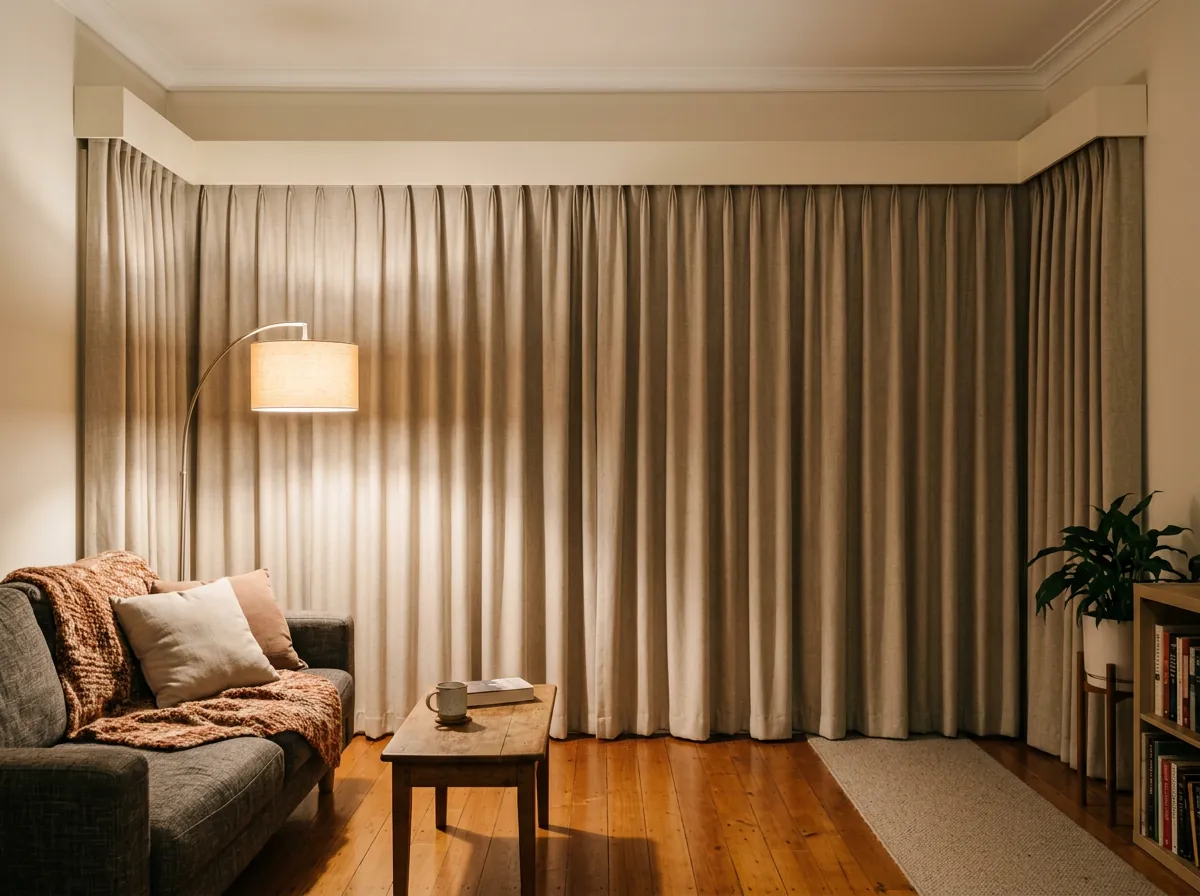
Each feature closes a path for air to move between the cold glass and the room. A curtain that stops at the sill leaves a gap at the bottom. A curtain on an open rod leaves one at the top. A curtain that ends at the frame leaves one at each side.
Fabric matters too, and we've covered it already. Our guide to material for curtains explains which fabrics suit which room. A fabric supplier quoted on Homes To Love notes that velvet has good thermal qualities.
For the drop, see How Curtains Should Fall. For pelmets and tracks, see Curtain Tracks, Rods & Pelmets. Lined styles are on our Drapes & Lined Curtains page.
Check for draughts before you count on the curtains
A curtain can't do much against a gap in the frame. Energy.gov.au lists the signs: rattling or whistling in wind, "moving curtains" or a breeze near closed windows. The fixes it suggests are foam strips around frames or sealant or gap filler rod around architraves.
If your curtain sways with the window shut, there is likely a gap in the frame, not a problem with the fabric. Fix the frame first. Then the curtain has still air to hold.
Keep the summer sheers and layer a lined drape with them
You don't have to take the sheers down. With a double track, the sheer can hang in front of the drape. The sheer keeps its daytime job of privacy. The lined drape closes across the window once the sun stops shining in.
Layering also fits the ACT's advice to choose tightly woven materials, trapping air in as many layers as possible.
See our Sheer Curtains page for the light layer. How a heading stacks decides how much window a drawn-back drape leaves clear, and our guide to types of curtain headings walks through each one.
Morning light after the change: bedrooms and shift sleepers
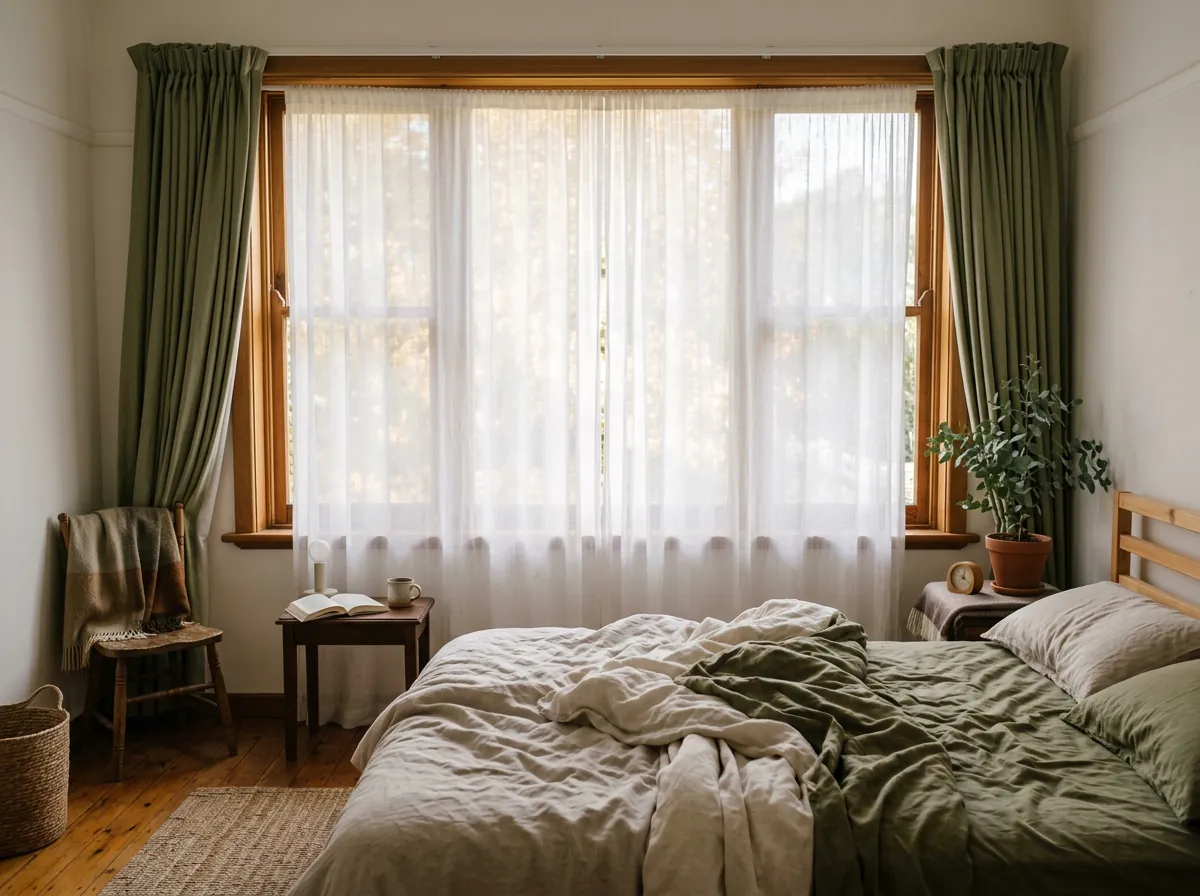
The NSW Government puts it simply: the clocks go back, “giving you more daylight in the morning”. Its tips for the change include shifting bedtime by 15 minutes a night beforehand, getting outside in the morning light, and keeping a consistent sleep schedule.
If a bedroom faces the morning sun, you'll see that light at an earlier clock time. For anyone who sleeps in daylight hours, such as a shift worker, a room you can darken on your own schedule helps you keep that schedule.
Day and night curtains pair a sheer with a heavier layer, so you choose the light. One trade source explains that a triple-weave fabric gives blockout with some light filtering, while a coated fabric gives 100% blockout.
How dark a room gets also depends on the gaps at the top and sides, which are the same gaps that let heat out. See Day & Night Curtains and our Curtain Fabric Guide on weight and light.
If you add corded curtains or a new track
| What | Requirement (national standard) |
|---|---|
| Loose cord | Must not form a loop of 220 mm or longer at or below 1,600 mm above the floor |
| Cleat | At least 1,600 mm above the floor |
| Label | The installer attaches a label with their name and contact details |
| What | Child safety around blind and curtain cords |
| Cots and beds | Keep them away from cords |
| Continuous-loop pull-cords that cannot be cut | Need a safety device |
An autumn changeover sometimes means new hardware. If cords or chains are involved, national safety standards apply, and NSW Fair Trading explains them. NSW Fair Trading says a loose cord must not form a loop of 220 mm or longer at or below 1,600 mm above the floor (checked October 2026). A cleat must be at least 1,600 mm above the floor. The installer must attach a label with their name and contact details.
Keep cots and beds away from cords. Some continuous-loop pull-cords cannot be cut and need a safety device.
Your autumn changeover at a glance
- Open while the sun is shining in
- Close when it is no longer shining in
- Check for draughts
Four figures sit behind the routine. Daylight saving ends on Sunday 4 April 2027, 3am AEDT back to 2am. Newcastle's mean minimum falls from 15.4°C in April to 8.5°C in July. Up to 40% of heating energy is lost through windows. And a winter day brings 5 hours or fewer of solar gain against 19 or more hours of night-time loss.
Open while the sun is shining in. Close when it stops. Check the frames.
Planning lined curtains for winter
Walk each room on the weekend the clocks go back. Look for curtains that stop short of the floor, have no lining, end at the window frame or sit under an open rod. Those are the windows to start with.
If you'd like help with lining, length, a pelmet or a second track for your summer sheers, tell Curtains Newcastle about the rooms through our Book a Free Measure & Quote page.
Sources
- https://www.bom.gov.au/climate/averages/tables/cw_061055.shtml
- https://www.yourhome.gov.au/passive-design/passive-heating
- https://www.yourhome.gov.au/passive-design/glazing
- https://www.nsw.gov.au/about-nsw/daylight-saving
- https://www.energy.gov.au/households/windows
- https://www.climatechoices.act.gov.au/energy/energy-efficiency/window-glazing-or-treatments
- https://www.homestolove.com.au/decorating/expert-tips-on-how-to-choose-curtain-fabric-15942/
- https://www.nsw.gov.au/legal-and-justice/consumer-rights-and-protection/safety/other-consumer-products/blind-and-curtain-safety
Pictures in this guide are illustrations, not photos of our jobs.